What Is Unit Price? The Beginner's Guide to Smarter Grocery Shopping
Unit price is the one number that strips away packaging tricks and tells you exactly how much you are paying for what you actually get. Many supermarkets are legally required to display it — yet most shoppers walk straight past it. This guide explains what it is, how to read it, and how to use it every time you shop.
What Is Unit Price?
Unit price (also called price per unit) is the cost of a product expressed per standard measure — such as per millilitre, per gram, or per piece. It lets you compare products of different sizes fairly, on an apples-to-apples basis.
Common unit price formats you will encounter:
- Per ml — used for drinks, shampoo, dish soap, cooking oil
- Per g (gram) — used for rice, sugar, yogurt, cheese, coffee
- Per piece / per sheet — used for tissues, wipes, paper cups, bin bags
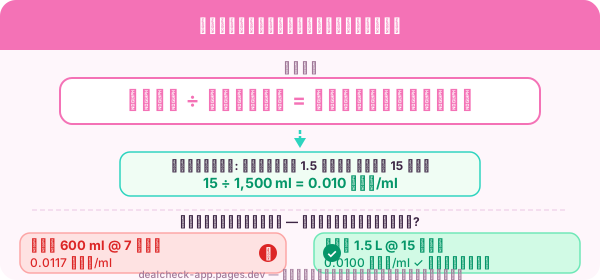
There is only one formula to remember: Unit Price = Total Price ÷ Total Quantity
Why Does It Matter?
Imagine you are standing in front of a shelf of drinking water with two options:
- A 600 ml bottle priced at 7 THB
- A 1.5-litre (1,500 ml) bottle priced at 15 THB
The large bottle looks cheaper — but is it really?
1.5 L @ 15 THB → 15 ÷ 1,500 = 0.0100 THB/ml
Large bottle is 14.5% cheaper per ml
In this case the large bottle wins. But what if the large bottle were priced at 18 THB instead?
Now it is slightly MORE expensive than the small bottle — buy small!
This is why you must always calculate. The number on the promotional sticker is designed to attract attention; the unit price is what tells you the truth.
How to Read Supermarket Shelf Labels
Major supermarket chains in Thailand and many other countries are required by law to display unit prices on shelf edge labels. Here is how to find and read them:
- Look for the small number — it usually appears in small text at the bottom-left corner of the price label, below the main price.
- Match the units before comparing — one label might say "per 100 ml" while another says "per litre." Convert to the same unit before you compare.
- Convenience stores often omit it — smaller shops and 7-Elevens rarely display unit prices. You will need to calculate yourself or use an app.
The simplest approach: photograph both price labels and let a calculator (or DealCheck) do the division for you.
When Unit Price Can Be Misleading
Even unit price has traps worth knowing about:
Bonus Items in the Pack
A pack labelled "12 pieces + 2 free" actually contains 14 pieces. Some shelf labels calculate the unit price based on only 12, making the pack appear more expensive than it is. Always divide by the real total quantity including bonuses.
Promotions Not Reflected on the Label
When a "buy 2, get 20% off" deal is running, the unit price printed on the shelf label is usually still the normal single-unit price. You must calculate the post-promotion unit price yourself:
Buy 2, get 20% off: (85 × 2 × 0.8) ÷ 2,000 ml = 0.068 THB/ml
Always compute the after-discount unit price to compare fairly
Different Units Across Brands
Brand A might list orange juice in litres while Brand B lists it in kilograms. Liquids close to water density are roughly interchangeable (1 L ≈ 1 kg), but this is not exact for heavier juices or syrups. Watch out for unit mismatches before drawing conclusions.
Packaging Air and Net Weight
Crisp and snack bags are often mostly air. The weight shown on the packet is the net weight of food, not the total pack weight — so the comparison is valid. However, the oversized bag can make the product feel more generous than it is. Always trust the numbers, not the packaging.
Let DealCheck Do the Maths Automatically
Enter the price and quantity for two products and DealCheck instantly shows you which is cheaper per unit — no mental arithmetic needed, right in the supermarket aisle.
Compare Prices NowMaking Unit Price a Shopping Habit
- Compare every time two sizes exist — It takes under 30 seconds but can save hundreds of baht a month across a full grocery shop.
- Memorise the one formula — Price ÷ Quantity = Unit Price. Repeat it until it is second nature.
- Never trust the sticker price alone — Promotional pricing is designed to catch the eye. Unit price is the honest number.
- Use an app for multi-item comparisons — When comparing several products at once, DealCheck handles all the calculations in one place.
Once you start comparing unit prices, you will find that the "obvious" choice in the supermarket is often the wrong one — and the savings add up quickly.