Why Multi-Packs Are Sometimes More Expensive Than Singles
Believe it or not — in 30–40% of cases, the price per unit in a supermarket multi-pack is actually higher than buying singles. This isn't accidental. It's a deliberate pricing strategy used by major retailers worldwide — and most shoppers never notice.
A Real Example From the Supermarket Aisle
Here's a scenario you've almost certainly encountered:
- Cola, single 12oz can: $0.89 per can
- Cola, 6-pack (12oz × 6 = 72oz): $5.79
The 6-pack looks like a deal — you're buying in bulk, it must be cheaper, right? Let's do the math:
6-pack price: $5.79
Difference: the 6-pack costs $0.45 more (8% more expensive)
You're not misreading it — the multi-pack is more expensive than buying the same quantity as singles.
Why Do Supermarkets Do This?
There are four main reasons:
1. "Bigger pack = cheaper" is a cognitive bias
This is a well-documented cognitive bias that retailers exploit. We grew up believing "bulk is always cheaper" — so we don't bother to calculate when we see a pack. The assumption does the work for the retailer.
2. Singles are priced as loss leaders
Stores sometimes sell individual items at or near cost to drive foot traffic, hoping you'll fill your basket with other items. The profit comes from the multi-pack — where shoppers are less likely to do the per-unit math.
3. Packs have a "convenience premium"
Retailers reason that shoppers will pay extra for the convenience of not picking up individual items one by one. Sometimes that's a fair exchange — but often we pay the premium without realizing it.
4. Shelf placement favors packs
Singles are often stocked low on the shelf or in a corner — multi-packs are at eye level, making them feel like the obvious or only choice when you're moving quickly through the aisle.
When Multi-Packs Actually Are Cheaper
It's not all bad news — some multi-packs genuinely save money:
- Heavy staples — large bags of rice, flour, sugar typically offer 10–20% savings per unit
- Long shelf-life products — laundry detergent, dish soap, cleaning supplies usually offer 5–15% savings in bulk sizes
- Items on a genuine "pack promo" — when the retailer is running a real promotion on the larger size (always verify)
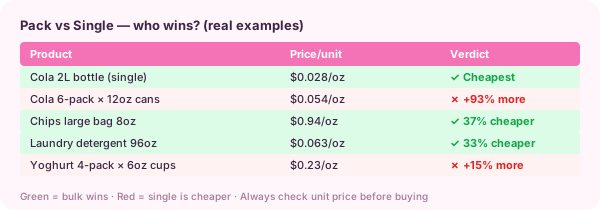
Real Examples — 4 Common Supermarket Cases
| Product | Price per unit | Better value? |
|---|---|---|
| Cola 2L bottle (single) | $0.028/oz | ✅ Cheapest |
| Cola 6-pack × 12oz cans | $0.054/oz | ❌ 93% more expensive |
| Chips, small bag 1oz | $1.49/oz | ❌ |
| Chips, large bag 8oz | $0.94/oz | ✅ 37% cheaper |
| Laundry detergent 32oz | $0.094/oz | ❌ |
| Laundry detergent 96oz | $0.063/oz | ✅ 33% cheaper |
| Yoghurt, single cup 6oz | $0.20/oz | ✅ |
| Yoghurt, 4-pack × 6oz cups | $0.23/oz | ❌ 15% more expensive |
Pattern: Long shelf-life products (detergent) usually benefit from bulk. Drinks and fresh/refrigerated items frequently don't. There is no universal rule — you have to check.
How to Catch It — 30 Seconds Before You Grab
- Check the unit price tag — the small print below the main price on the shelf label
- If there's no unit price shown, or sizes differ — open DealCheck
- Use Pack mode for multi-packs (enter quantity × size per unit)
- Compare single vs pack — you'll see instantly which is cheaper per unit
Don't guess — compare in seconds
DealCheck supports pack mode — enter "6 × 12oz" and the app calculates the total volume and price per unit automatically.
📦 Compare packs nowSummary
- 🚨 30–40% of multi-packs in supermarkets cost more per unit than buying singles
- 💡 Why: cognitive bias + deliberate supermarket pricing strategy
- ✅ When packs win: heavy staples (rice, flour), long shelf-life (detergent, soap), genuine pack promotions
- ❌ When packs lose: drinks, fresh/refrigerated items, snacks
- 📱 How to catch it: calculate unit price every time — use DealCheck if the math isn't on the label
Next time you reach for a multi-pack — pause for 30 seconds. Pick up the single, enter both into DealCheck, and check. The result will surprise you more often than you'd expect.