Bulk Buying vs Single Items — Does Bigger Always Mean Cheaper?
Many shoppers assume that buying in bulk is always cheaper — but in reality, single items or smaller packs sometimes win on unit price, especially when the small size has a promotion running. Before you toss that jumbo pack in your cart, it pays to do the math first.
When Bulk Buying Actually Wins
Buying in bulk or choosing the large pack makes the most sense when all three of these conditions are true at once:
- You use it regularly — Everyday staples like drinking water, soap, or dish soap are almost certain to be used up before they expire.
- It has a long shelf life — Tissues, laundry powder, and shampoo keep for months or years. Yogurt or bread? Not so much.
- The unit price is genuinely lower — You must always calculate. Larger packs are sometimes priced so that the per-unit cost is no cheaper than buying single.
A clear-cut example: a 12-pack of 500 ml water bottles priced at 60 THB versus buying one bottle at a time for 7 THB.
Single: 7 ÷ 1 = 7.00 THB/bottle
Bulk is cheaper by 28.6%
Bulk wins clearly here — as long as you have storage space and will actually use all 12 bottles.
When Buying Single Is the Smarter Move
Don't fall into the "bigger = cheaper" trap. There are several situations where picking the smaller size is the wiser choice:
- Short expiry date — Yogurt, fresh milk, and bread spoil fast. If you buy more than you can eat, the effective cost per serving skyrockets once you throw some away.
- You rarely use it — Buying a large jar of a specialty condiment you reach for once a month means it will likely expire before it is finished.
- A promotion on the single item beats the bulk price — When a small pack has a buy-one-get-one deal (50% off), it can easily undercut a large pack that is only 20–30% cheaper per unit.
- You want to try something new — Always buy the small size first when you are uncertain whether you will like a product, to avoid wasting money on something that sits unused.
Real Examples — Unit Price Calculations
Here are common supermarket items with actual numbers worked out:
Drinking Water
12-pack of 600 ml bottles @ 60 THB → 60 ÷ 7,200 = 0.0083 THB/ml
Winner: Bulk pack (29% cheaper)
Dish Soap
Large 3,000 ml bottle @ 180 THB → 180 ÷ 3,000 = 0.060 THB/ml
Winner: Large bottle (14% cheaper)
Yogurt
4-pack of 150 g cups @ 65 THB → 65 ÷ 600 = 0.108 THB/g
Winner: Single cup! (the 4-pack is 8% more expensive per gram)
Tissues
Large 12-roll pack @ 99 THB → 99 ÷ 12 = 8.25 THB/roll
Winner: Large pack (15% cheaper)
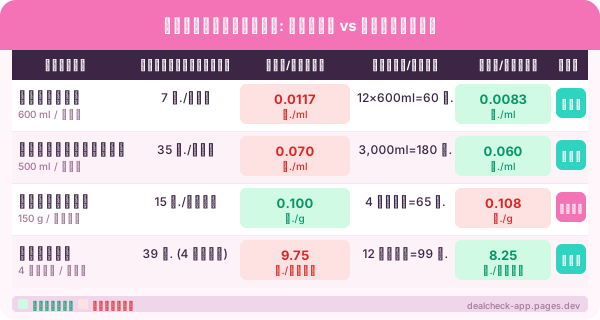
| Item | Single (THB/unit) | Bulk (THB/unit) | Winner |
|---|---|---|---|
| Drinking water | 0.0117/ml | 0.0083/ml | Bulk pack ✓ |
| Dish soap | 0.070/ml | 0.060/ml | Large bottle ✓ |
| Yogurt | 0.100/g | 0.108/g | Single cup ✓ |
| Tissues | 9.75/roll | 8.25/roll | Large pack ✓ |
A Quick Checklist Before You Buy Bulk
Ask yourself these four questions every time you reach for the large size:
- Calculate the unit price — Divide the total price by the quantity (ml, g, or number of pieces) for both options.
- Check the expiry date — If you cannot use it in time, the lower unit price is meaningless.
- Check for promotions on the smaller size — A BOGO deal on a small pack (equivalent to 50% off) may beat the bulk price.
- Consider storage space — A cluttered home has hidden costs too. Buying less but buying right is a valid strategy.
Skip the Mental Arithmetic
Use DealCheck — enter the price and quantity for both packs and the app instantly tells you which is cheaper per unit, right on your phone in the aisle.
Compare Prices NowThe bottom line: bulk is not always cheaper — but when the unit price works out and you will actually use it all, go for it. DealCheck makes that comparison take less than 10 seconds.